



Why Go Back? Reasons to Return to School, Part I
Date: September 22, 2022
Why go back? Reasons to return to school are vast. To answer that question, let’s ask one of our students, Akram. Akram Shafik, a native of Cairo, Egypt, worked as a high school and middle school teacher for nearly 18 years before immigrating from the Middle East to the U.S. With a desire to reinvent himself, Shafik consequently enrolled in what was then Brightwood College in 2017.
Then, when Gurnick Academy of Medical Arts took ownership of Brightwood’s facility, Shafik enrolled in Gurnick Academy’s Associate of Occupational Science (A.O.S.) in Radiologic Technology Program at the Van Nuys Campus. With coursework in various core sciences, including radiological safety, physics, and medical terminology, Akram surmounted many obstacles in his 24-month degree program.
Besides full-time courses, Akram also worked full-time while juggling familial commitments at home. Additionally, using his native Arabic language, he assisted fellow immigrant students in the program. Often, they had late-night study sessions and began their days at 4 AM.
Why Go Back?
Akram says he went back to school first for the love of learning. “Acquiring new skills is the golden key to being employable,” he says. Another reason was “to have a license in one of the professions by which I can get a good position,” he says. “So that I could improve my standard of living.”
While the reasons for going back differ for everyone, some students return to improve their current situations. Others enter classroom doors again to finish degrees they walked out on decades prior. Some re-enter due to displaced skill sets. Still, others return during times of transition, i.e., they experience a move, lose a job, etc.
Whether by whimsical curiosity or dire need, societal trends have shifted, making “the college return” almost trendy. In light of this, a recent study in New York of 2,000 parents polled showed that 44 percent planned to return to college.1 Whereas, from 2010 to 2019, the percentage of people ages 25 and older with a Bachelor’s degree or higher jumped from 29.9–36.0 percent.2
Go Back For Current Healthcare Offerings*

Pictured Above: A Gurnick Academy of Medical Arts student receives their diploma.
Akram says his degree gave him stability. “I feel I have more job security as I was hired by a great organization (Cedars-Sinai). Furthermore, it is easier now to move into another city or even a state if I need to without starting from scratch,” he says. Akram’s quote speaks to two allied healthcare education realities: stability and expansion.*
Go Back For Stability*
According to Indeed Career Guide, healthcare offerings often include fulfilling work, good earning potential,3 strong job outlook,3 stimulating work environment, a variety of career options, opportunities such as travel or positions within varying educational levels, and flexible schedules.4*
Go Back For Expansion*
According to the Bureau of Labor Statistics, healthcare employment is projected to grow 16 percent from 2020 to 2030.5 This is faster than the average for all other occupations—equaling roughly 2.6 million new jobs. Simultaneously, the industry is projected to bring more employment than any other occupational group.5*
Moreover, newfound course commitments and maturity frequently garner academic “side effects” not felt by 20-somethings. For example, as returning students master new subjects, they can combine past life experiences. Regularly, this pairing better equips them with pronounced soft skills like compassion and empathy.
Tackle That List of Obstacles to Return
Delaying vs. jumping in? There’s never going to be that perfect time. Concurrently, there’s always going to be a list of obstacles. (Everyone has a list.) According to Akram, his obstacles presented as language and cultural barriers. Other challenges (besides Arabic) manifested as:
- Time limitations;
- Family commitments (taking care of my family and my kids’ educational needs);
- Fear of being in debt (school loans);
- Understanding medical terminology and complex topics.
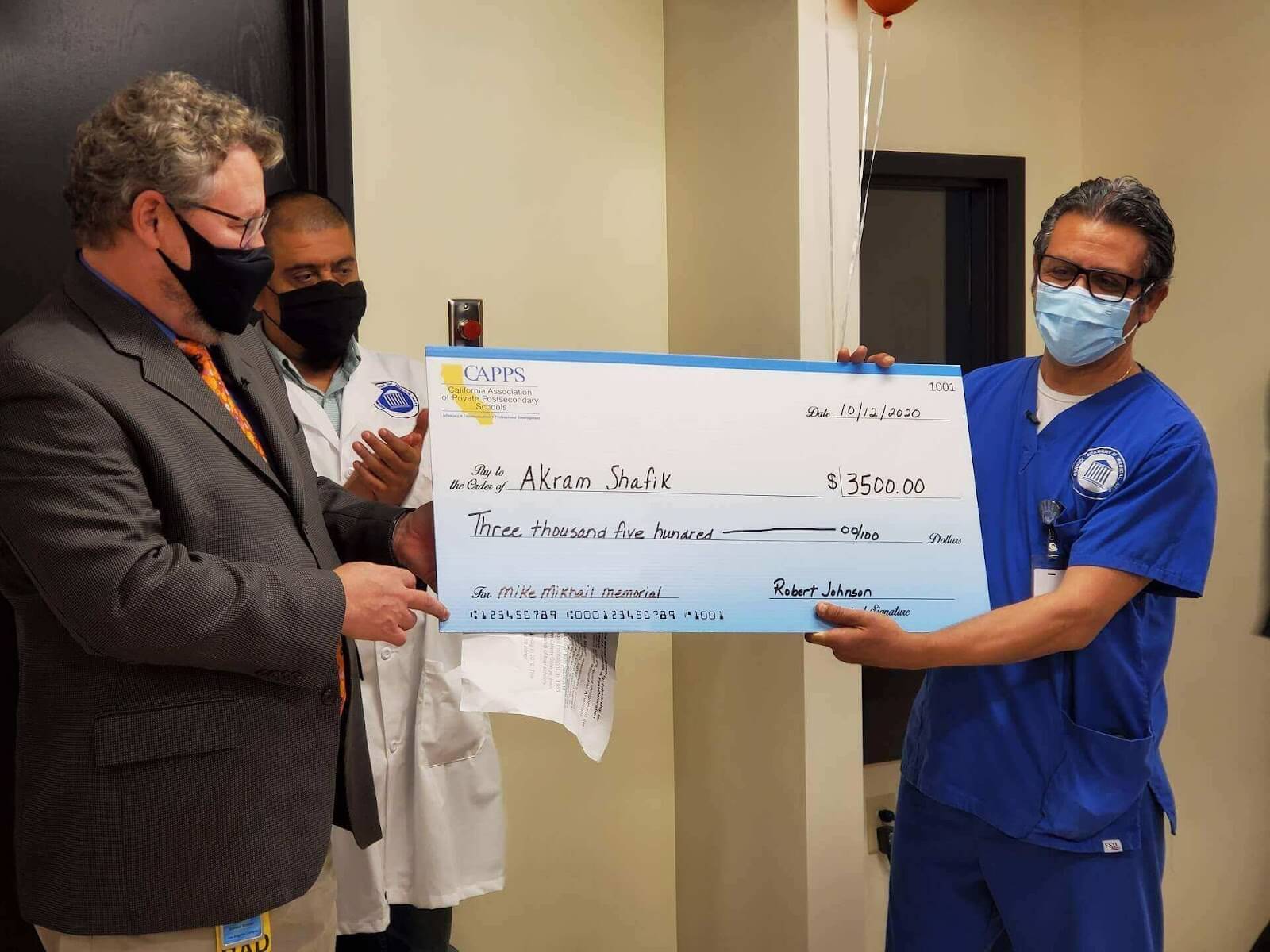
Nonetheless, his barriers were not insurmountable. By September 2018, Akram earned his X-ray Technician with a Medical Assistant diploma. Then, in 2020, Akram received the California Association for Private and Postsecondary Schools (CAPPS) Mike Mikhail Memorial Scholarship for Recent Immigrants and First-Generation Americans. By August 2021, Akram graduated with a Radiologic Technologist Associate degree from Gurnick Academy with a 4.0 GPA.
Why Go Back? Reminders For the Return
In the first place, college takes determination for all. At the same time, the mature student is generally not on the same playing field as a fraternity mate. Instead, the forty- or fifty-something tackles academia with responsibilities in tow, i.e., ) a child, mortgage, prior commitments, etc. Furthermore, like Akram, getting through may take getting up earlier than one’s family members and hitting the books hard. It may take honing those not-yet-developed computer skills (even purchasing a computer), learning to Zoom, or tackling FAFSA applications.
Additionally, if you’re bracing for the journey, first remember you don’t go it alone.
Additionally, if you’re bracing for the journey, first remember you don’t go it alone. Understanding teachers, study groups, and colleagues await. Second, remember resources abound. For almost every obstacle, there’s a solution. We live in a resource-driven age, i.e.), Google, YouTube, Cliff Notes, electronic flashcards, and translation devices. Gurnick Academy of Medical Arts offers a Student Services Association with a plethora of support, including stress management tips, an online counseling network, and class ambassadors.
Finally, remember your college trajectory isn’t F-O-R-E-V-E-R. Nonetheless, coursework has a beginning and an end. After all, this too shall pass.
Why Go Back? Why Not Go Back?
Moreover, “Don’t ever let someone tell you that you can’t do something,” says Akram. “If you’ve got a dream, you’ve got to protect it. People who can’t do something themselves often want to tell you that you can’t do it. But if you want something, get it! Period!”
Why go back? Find your reasons to return to school today. Counting your reasons, you’ll likely find out the question isn’t “Why go back? But instead, “Why not go back?” ~
*Opportunities in healthcare vary from person to person.
Written by Cindy R. Chamberlin, 2022.